

Women More Likely to Be Misdiagnosed After Heart Attack Due To "Gender Data Gap" in Medical Research
UK aligning with US Healthcare and Medical Reasearch?
New NHS Agreement with US increases cost of drugs and gives UK public opportunity for US drug company trials
Women face significantly worse health outcomes than men due to decades of male-dominated medical research — and a leading UK charity is pushing to change that.
 The Medical Research Foundation has highlighted what researchers call the "gender data gap": the fact that the vast majority of medical data has historically been based on male bodies and male experiences. Women are 50% more likely to be misdiagnosed following a heart attack, and therefore more likely to suffer serious outcomes — simply because they are female.
The problem begins at the most basic level of scientific enquiry. Cell lines used in laboratory research have a biological sex, and male cells respond differently to female cells — for example in the way they metabolise drugs, or how an immune cell reacts to an invading virus. Yet a recent study found that fewer than half of scientific studies report the sex of their cells, and where they do, they are more likely to use male cells.
Clinical trials have historically compounded the problem. Following the thalidomide scandal, the US Food and Drug Administration in 1977 advised that women of childbearing potential be excluded from drug trials. Although that guidance was reversed in the 1990s, it meant women were excluded from trials for decades — leaving researchers to assume that findings from male subjects applied equally to women.
Of the ten drugs withdrawn from the US market between 1997 and 2000, eight posed a greater health risk to women than men, due to trials having poorly accounted for sex and gender.
The consequences extend beyond heart disease. From dementia to diabetes, and osteoporosis to obesity, sex and gender differences remain neglected in UK and international research.
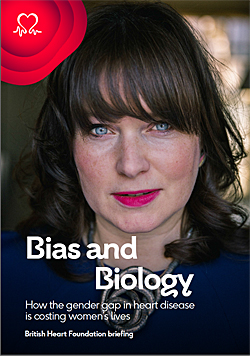
The British Heart Foundation website has this about Women and heart attacks:
Over 300 million women worldwide live with cardiovascular disease, and it’s the biggest killer of women globally. Yet for many, the disease remains undetected.
 At least 60 million women globally live with stable chest pain, known as angina. However, each year, a subset of these women undergo invasive heart tests called angiograms and leave without a diagnosis. They may be told their arteries look “normal”, that their hearts are healthy, and that it might be anxiety.
In people with stable angina, the most common diagnosis is coronary heart disease due to a blockage or narrowing in a major coronary artery, so medicine has spent decades learning to find and fix these obstructions.
But two out of three women with stable angina who undergo a coronary angiogram don’t have any obvious problems like blockages in their arteries.
They have what’s known as ANOCA (angina with no obstructive coronary arteries). In most of these women, ANOCA is caused by disease in the heart's smallest blood vessels, known as coronary microvascular disease (CMD), though there are other causes such as coronary vasospasm. It doesn't show up on angiograms, which means it is often missed.
The result of healthcare systems set up to find blockages in the main coronary arteries is a diagnostic odyssey, leaving a population – mainly women – without answers.
Profound consequences
The consequences are profound. Seven in 10 women with ANOCA report adverse effects on mental health, and eight in 10 report impacts on their social lives.
Seven in 10 report adverse effects at work, with many reducing hours, retiring early, or moving into lower-paid roles.
The economic cost is equally staggering – healthcare systems spend thousands per patient on tests designed to detect blockages that aren’t there.
Major funders in other countries have moved to address the issue. The European Commission now requires all Horizon programme proposals to include intersectional sex and gender analysis unless exclusion is justified, and the US National Institutes of Health implemented its Advancing Science for the Health of Women programme in 2019. The results have been striking: following Canada's adoption of a similar policy in 2010, the proportion of funding applications considering sex rose from 22% to 83% within a decade, and Canadian research publications accounting for sex or gender rose by 64%.
The UK, however, has lagged behind. In contrast to Canada, the United States, and European nations under Horizon Europe, the UK has no standard, unified guidance for researchers on how to consider sex dimensions in their studies.
To fill that gap, the Medical Research Foundation has joined the MESSAGE (Medical Science Sex and Gender Equity) project, a cross-sector initiative hosted by The George Institute for Global Health. The project brings together government funders, charitable organisations, regulatory bodies, patient representatives, researchers, and publishers — including The Lancet Group and The BMJ — to co-design a sex and gender policy framework for the UK.
The Foundation has also taken steps of its own. Since early 2022, it has required all grant applicants to explain how the sex and gender dimension of their research has been accounted for in experimental design — and if not, why not. Peer reviewers and expert panel members have also been guided to assess this specifically.
"The first step is to recognise that, by closing the sex and gender gap in medical research, we can fund higher quality science which can make a genuinely life-changing difference for women, as well as men," said Dr Alison Simmons, the Foundation's Director of Research.
Source: Medical Research Foundation
